
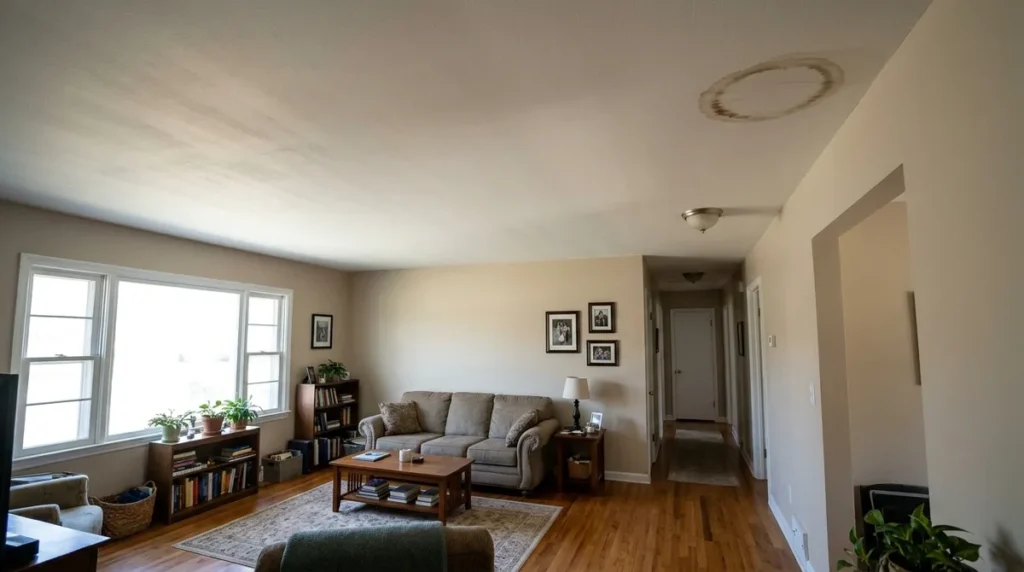
A brown ring on the ceiling tells you water got in. It does not tell you where. Most people study the shingles above the stain. That patch is usually sound. The water came in higher up the slope and dropped where you see it. Learning how to find a roof leak means reading that hidden path backwards, from stain to opening.
Short answer: start in the attic, not on the roof. Look uphill for dark tracks on the decking and wet lines down the rafters. The top of that track sits near the entry point, nearly always a joint or fitting: flashing, a pipe boot, a valley, a vent. To trace a roof leak, work uphill, not above the stain.
How Water Travels Inside a Roof Before It Drips
A roof is built in layers, and water moves between them. Rain slips through one spot, lands on the underlayment or decking, and runs along the deck or down a rafter until it finds a nail hole or a board joint. Only there does it drip through and mark the ceiling.
Water travels several feet sideways and downhill before it drops, so the hallway stain may start above a bedroom, sometimes in a different room altogether. Where two surfaces lie close together, flashing against brick or shingle over underlayment, water is pulled sideways by capillary action. Wind-driven rain makes the path stranger. In Eastern NC, heavy rain often arrives sideways, pushed by storm winds off the rivers and the coast. A leak that only appears in big storms still tells you which joint the wind can reach.
The stain is late, too. Decking, insulation, and drywall soak through first, so a stain can appear hours or days after the rain that caused it. A dry ceiling the morning after a storm does not clear the roof.
Painting over the stain hides the warning, not the leak. Patching the shingles right above it misses too, because the opening sits higher up the slope, and the patch can trap moisture against the deck.
Before you climb into the attic, read the stain itself. A darker ringed edge means it has wet and dried repeatedly, so the leak is active. A stain showing only after long, heavy rain points to a joint that fails under pushed water. Measure its distance from two outside walls. In the attic, one patch of insulation looks like another.
Is It Even the Roof? Roof Leak vs Plumbing Leak vs Condensation
- The stain appears or grows only during rain, or just after it: suspect the roof.
- It grows in dry weather, or right after showers, baths, or a laundry run: suspect plumbing.
- It shows up in a cold snap with no rain, or near the air handler in summer: suspect condensation or the cooling system.
Not every water stain is a roof leak. A slow supply line drip ignores the weather. Warm, moist house air condenses on cold attic surfaces, often where a bathroom fan vents into the attic. If your pattern matches the first line, keep reading.
How to Find a Roof Leak From the Attic, Step by Step
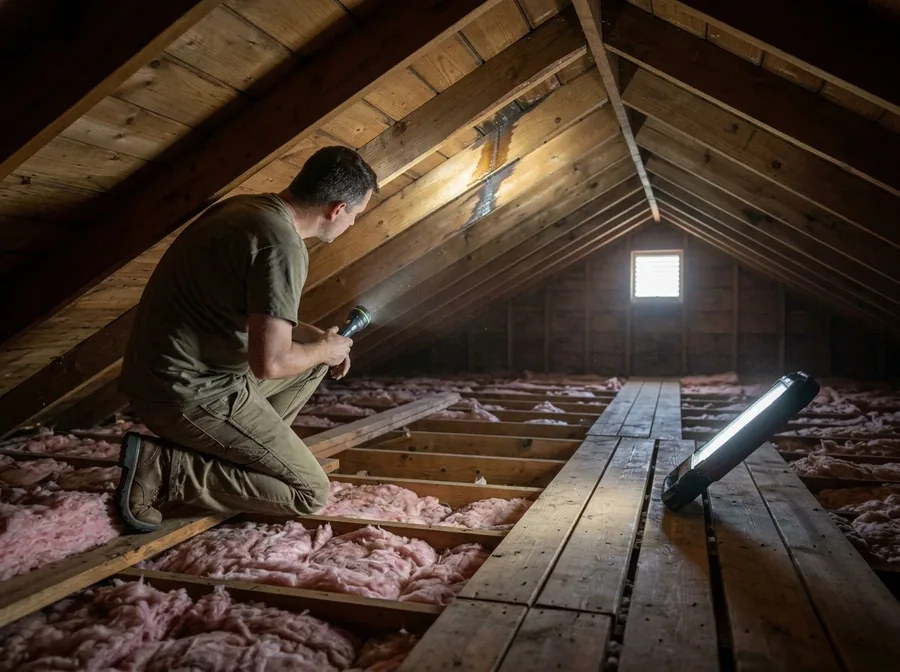
Take a strong flashlight or a headlamp, plus a tape measure, chalk, painter’s tape, and a dust mask. Go up during a steady rain, or soon after. Days later the trail may be gone. In summer, go early: by midday an Eastern NC attic is hot enough to be a health risk. Note the rain: how hard, how long, which way the wind drove it.
Safety first: step only on joists or boards laid across them, never on the drywall between them. Do not climb onto the roof, above all when it is wet or steep. A wet shingle gives almost no grip. Leave roof surface work to a roofer.
- Start from the stain. Use your room measurements to find its matching spot on the attic floor.
- Look uphill, not down. The entry point sits between your mark and the ridge.
- Follow the track. Hold the flashlight low, at an angle. Wet wood shows as a dark line in its light. Follow it to its highest point, mark it with chalk, and date a strip of painter’s tape beside it, so the next storm shows whether the spot is new.
- Read the small clues. Turn the flashlight off and look for pinpricks of daylight through the decking. Each is a hole water uses (vent light does not count). Check the nail tips: rusty tips, backed-out nails, and shiners that missed the rafter sit on the track.
- Check the fittings first. Most tracks end at a pipe boot, vent, valley, or flashing.
Attic Clues and What Each One Means
| What you see in the attic | What it usually means |
|---|---|
| A dark track on the decking or down a rafter | The water’s path. Follow it uphill |
| A pinprick of daylight through the deck | A hole water uses (vent light does not count) |
| Rusty or backed-out nail tips | Water has reached that spot for a while |
| Matted, dark insulation with a musty smell | Water sits or pools there |
| Frost or a fine film spread wide across the deck | Condensation, not a leak |
Where the Track Ends: Flashing, Pipe Boots, and Valleys
Nearly every track ends where the roof surface is cut, joined, or sealed.
Flashing. The metal strips sealing joints where a roof meets a wall, chimney, or slope. It leaks when it lifts, rusts through, or loses its seal. One warning: sealant smeared below a joint dams the water draining past it, backing it up until it comes through anyway.
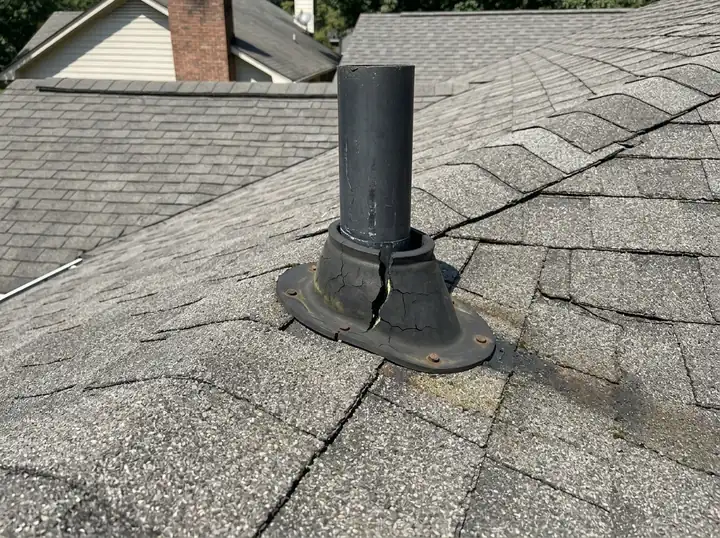
Pipe boots. The rubber collars around plumbing vents. The rubber usually cracks long before the shingles wear out, and the split tends to open on the side facing the sun. Heavy caulk smeared on a boot is a sign of an earlier failed fix. If the boot itself looks fine, check the shingle just above it, which can crack and send water down the pipe.
Valleys. The channels where two slopes meet, gathering all their water into one line and clogging with leaves and pine needles, so small faults get tested hard.
Vents, chimneys, and eaves. Ridge and box vents let wind-driven rain in when damaged or poorly seated. At the eaves, overflowing gutters spill water behind the fascia, so a stain hugging an outside wall means checking the gutter first.
Last fall, a homeowner in New Bern called us about a stain over her kitchen. In the attic, the track ran uphill along a rafter and ended two rafters over, at a pipe boot above the bathroom, its collar split on the sunny side. The stain was never under the leak. We replaced the boot, and the kitchen ceiling stayed dry through the next storm.
The full breakdown of each spot and how it fails is in our guide to where roofs actually leak.
If your track tops out at worn flashing over a Washington room, our roof repair team in Washington NC handles that fix, as do our leak repair work for New Bern homes and our roof repair service in Greenville NC.
The Hose Test: How a Hidden Roof Leak Gets Confirmed
Short answer: two people, one hose, low to high, one slope at a time, with a watcher in the attic.
When the trace points to one slope but the opening stays hidden, a water test settles it. A roofer should run the roof side: one person on the hose, a second in the attic with flashlight and phone, watching for the first drip. Start low, wet one small section at a time, and work uphill, giving each section 10 to 15 minutes.
Two limits matter. Never spray upward under the shingle laps: a hose pointed uphill forces water into joints that shed real storms, inventing leaks. And a clean test does not clear the roof: a hose cannot copy wind, so an intermittent roof leak that only fires in sideways rain can pass, then leak in the next big storm.
Photos and Notes That Make the Repair Visit Count
Photograph the stain from the room, with something in frame for scale. In the attic, photograph the track, its highest wet point, and the nearest fitting. Note the date, the kind of rain, and the detail most people skip: wind direction. A leak that only fires when rain blows from one side points at the fittings on the face that took the weather, and that note can cut the search in half. It also gives you a dated record for a claim later.
Note one more thing: how long into the rain the stain took to grow. A stain that shows within minutes points at an open path, a split flashing or a missing shingle. One that only appears after hours of steady rain points at something filling up first, a valley choked with debris or a gutter that cannot clear the water.
Old Stain or Active Leak? How to Tell the Difference
Not every stain is live; an old mark can sit for years after its opening was fixed. Draw a light pencil line around the edge and date it. Growth past it means water is still getting in. Press a dry paper towel to it after rain, and again after two dry days: damp means a live opening, bone dry through several rains means old damage. But a slow leak can sleep through a dry spell and return next season, so watch another storm cycle before covering it with stain-blocking primer.
Still Leaking After a Repair? Why Roof Leaks Return
Short answer: a returned leak is usually a diagnosis problem, not an effort problem. Either a second source was hiding behind the first, or the repair was made where the water showed instead of where it got in. Two openings can feed one stain; fixing the first unmasks the second, so the leak returns smaller, but still there. Hours of rain can change the picture too, filling a valley or gutter until it spills, which is why some returned leaks appear in only one weather pattern.
Ask for method, not more sealant. Have attic and roof sides checked together in one visit. Ask for dated photos of the suspected entry point before anything is covered, and ask what will be tested, such as a hose test, not what will be smeared on. If you are still asking where your roof is leaking after two failed patches, the need is not a third patch. It is the water watched while it moves. That is what real roof leak detection looks like.
If the leak began after other work on the roof, look there first. Solar mounts, a new vent, a satellite dish: each is a fresh hole, and new leaks point first to new penetrations. Call that company before patching anything yourself, and show them your photos and rain notes.
When to Call a Roofer About a Leak
The track may split, the attic may be too low or full of ductwork, or the entry point may hide under layers. Tracing a leak from inside the house has an honest limit. Some leaks take more than one visit to pin down.
Some leaks are emergencies. Water dripping from a light fixture or ceiling fan has reached wiring: leave the fixture alone, catch the water in a bucket, and turn that circuit off at the breaker. A ceiling that bulges or sags is holding water, so clear the room below and call the same day. Wet drywall and insulation should be dried within 24 to 48 hours to keep mold from starting, according to the EPA guide to mold and moisture.
Bring in a roofer when the stain keeps spreading, the decking feels soft underfoot, water drips instead of staining, or your trace stops at a fitting you can see is cracked or lifted. Prado’s Roofing NC LLC checks the attic and the roof in one visit, so the repair lands at the entry point, not under the stain. Our crew has 15 years of roofing experience across Washington, New Bern, Greenville, Belhaven, Chocowinity, and Bath. Call (252) 999-4827 or request a free roof inspection in Washington NC.
Roof Leak FAQs
Is the ceiling stain ever directly under the leak?
Sometimes, if a fitting sits right above the room, like a pipe boot over a bathroom. Usually water runs along decking or a rafter first, so the stain sits downhill from the opening.
What is an untraceable leak, and how does anyone track one down?
The name homeowners give a leak that survives guesses: stain found, roof above it sound, patching useless. It is rarely untraceable. Nobody has followed the attic track to its top yet.
I have a water stain on my ceiling but no obvious leak. Could it be plumbing instead of the roof?
Yes. The timing tells you: rain only means the roof; growth in dry weather or after showers, baths, or laundry means plumbing; damp with a cold snap and no rain means condensation.
How long after rain does a roof leak show up?
It varies, and the timing is a clue. Decking, insulation, and drywall soak through first, so a stain can show hours or days after the rain that caused it. A stain growing within minutes of rain starting points at an open path. One that needs hours of steady rain points at something filling up.
My roof was repaired twice and it is still dripping. What now?
Assume the diagnosis, not the effort, is the problem: a second source may hide behind the first, or earlier work sealed where water showed, not where it entered. Ask for attic and roof checked together, dated photos, and a test.
Can a hose test find a leak that rain keeps hiding?
Often, yes, once a trace has narrowed the search to one slope. Wet one small section at a time, low to high, with a watcher in the attic. Its two limits are in the hose test section above.
Can I trace a leak if my home has no attic access?
Only partly. Read the stain, note which rains make it grow, and check from the ground which fittings sit uphill of it. The same applies if the deck’s underside is covered in spray foam, which hides every track. Either way, the trace has to happen from the roof side. Do not cut a ceiling on a guess.
What should I show the roofer when they arrive?
The stain, your dated photos of it and of the attic track, and your rain notes, wind direction included.