
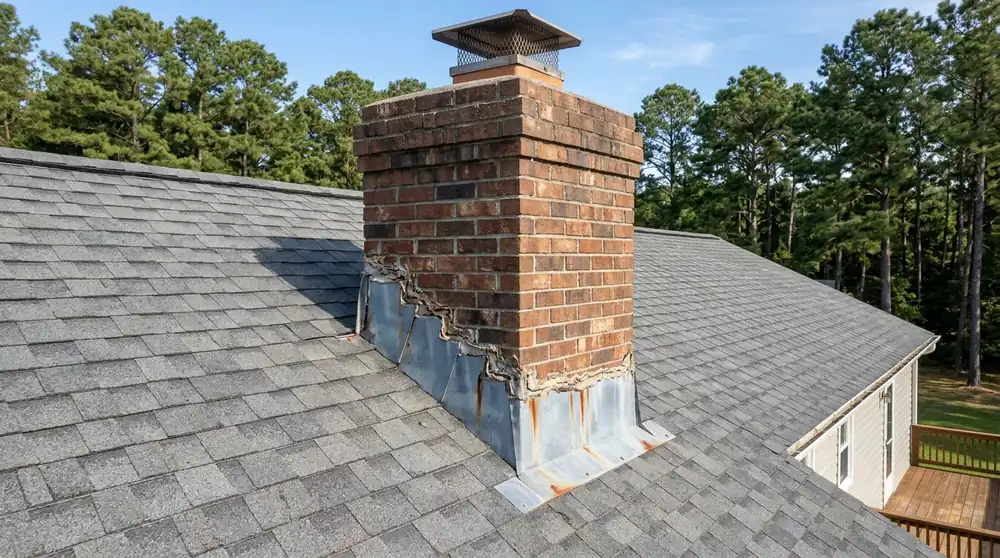
A roof that looks sound from the street can still leak, and the shingles are usually fine. So where do roof leaks start? Look at the joints first: water comes in where the roof surface stops being one flat sheet and has to join something else, a chimney, a vent pipe, a wall, or another slope.
Short answer: most leaks start at a joint, not in the middle of the shingles. Flashing around chimneys, walls, and skylights comes first, then rubber pipe boots around vent pipes, then valleys where two slopes meet. Learn those three and you can read most leaks from the ground.
Why Roof Leaks Start at Joints, Not Shingles
A shingle field is built to shed water. Each shingle overlaps the one below it, so rain runs downhill over the surface and off the edge. A joint is different. Where the roof meets a wall, a pipe pokes through the deck, or two slopes fold into a valley, the surface is cut, and something else has to close that cut, usually a thin piece of metal or rubber, held by nails and sealant.
That is why a ceiling stain so often sits under a roof that looks fine from the ground. The field did not fail. A joint did, and the water ran along the decking or a rafter before it dropped through the ceiling somewhere else. See our guide on how to find a roof leak from your attic.
Flashing Leaks: Chimneys, Walls, and Skylights
Flashing is thin metal, usually galvanized steel or aluminum, installed at every joint where shingles alone cannot seal the gap. It stops water by being layered in the right order, so every piece laps over the one below it and water keeps moving downhill, never uphill behind the joint.
Chimney Flashing
A chimney shows how the system works, because a chimney has four flashing parts, not one. Step flashing runs up each side as small L-shaped pieces, each one woven into the shingles. Counterflashing is set into the mortar joints of the chimney itself and folded down over the step flashing. Apron flashing wraps the low side and carries water back onto the shingles. Behind a wide chimney sits a cricket, a small peaked roof that splits the water and sends it around the chimney.
Each part fails in its own way. Step flashing shifts or was laid in the wrong order, and water runs behind it. Counterflashing slips out of an eroded mortar joint. A missing cricket lets water pool against the back of the chimney. Rust opens tiny holes where water sits longest, and homes near the Pamlico River and the sounds see it sooner, because salt air eats at metal flashing faster than it does inland. And the sealant at every edge dries, cracks, and pulls away years before the metal wears out. Sealant is the weakest link in the whole system, which is why a joint that depends on sealant instead of layered metal almost always fails first.
Roof-to-Wall and Kickout Flashing
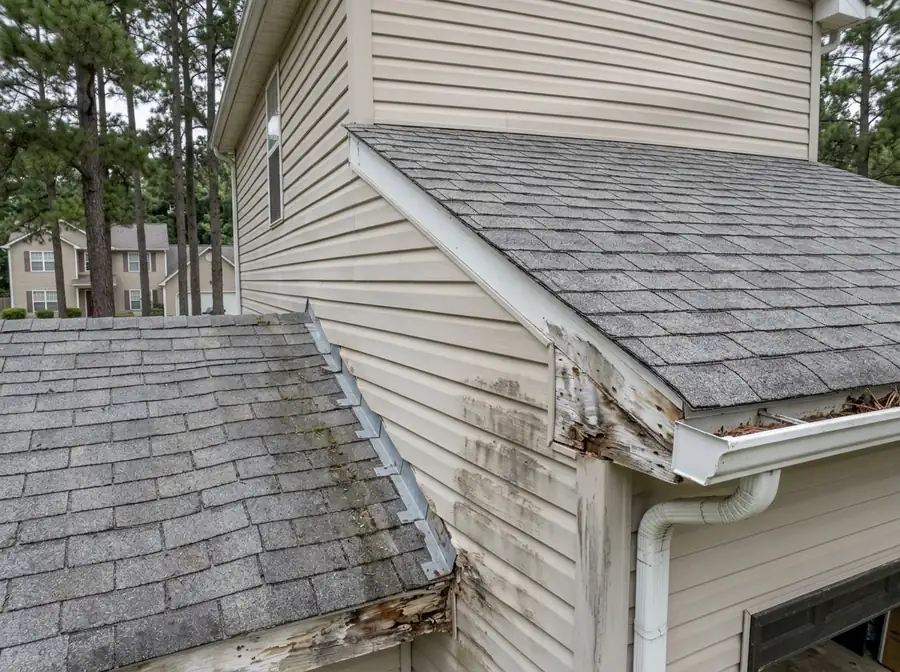
Roof-to-wall joints work the same way, with step flashing up the wall and counterflashing lapped behind the siding. Where that roof edge ends at the wall, a small bent piece called kickout flashing should turn the water out into the gutter. When it is missing, water runs straight down behind the siding, and the damage shows up as rot or stains on the wall below, not on a ceiling. A dead valley is the hardest version: a slope that runs down into a wall, where water and leaves collect in one corner.
Skylight Flashing
Skylights are flashing joints too, with metal around a raised curb, and when one leaks the curb flashing is usually the fault, not the glass.
Pipe Boot Leaks: The Most Predictable Roof Leak
A pipe boot seals the roof where a plumbing vent pipe passes through it. Each boot has a metal base nailed to the deck and shingled over, with a rubber collar gripping the pipe tight enough to shed water down its outside.
The collar is usually neoprene or EPDM rubber. Sun breaks rubber down. Ultraviolet light dries out its oils, the surface hardens, and fine cracks deepen into full splits. Heat makes it worse: a dark roof runs far hotter than the air on a summer afternoon, then cools fast at night, flexing a collar that has already gone stiff. A brittle collar cannot follow the movement of the pipe, so a gap opens around it, and water runs straight down the pipe into the attic.
A standard rubber boot lasts about 10 to 15 years, and Eastern NC sun and heat push most boots toward the short end of that range. A roof that is twelve years old can have shingles with years of life left and boots that are already splitting. That mismatch is why a boot leak is so common on a middle-aged roof.
Check the sunny side first. Cracks gather on the side that takes the most sun, so a boot can look sound from one angle and be split on the other. Big gobs of old caulk on a boot are a red flag, not a fix. A boot can also look guilty while being innocent. A common case: the vent is sealed twice and still leaks, because the real fault is a cracked shingle just above it. If a boot looks fine, look one course higher. From inside, a boot leak often shows as a stain on a bathroom ceiling, and in the attic the wet spot is often on one side of the pipe only.
Last spring, a homeowner in Washington called us about a stain on her bathroom ceiling. Two other roofers had already caulked the vent pipe, and the stain kept growing. When we checked the roof, the boot collar was split on the south side, the side that gets the most sun. Caulk was never going to close a split like that. We replaced the boot, and the leak stopped.
Valley Leaks: Where the Most Water Moves
A valley is the inside angle where two roof slopes meet and funnel their runoff down toward the gutter. Every drop that lands on both slopes runs through that one line, so a small defect there is stressed harder than anywhere else, and valley leaks tend to show up fast, and worst, in heavy rain.
Open, Closed-Cut, and Woven Valleys
There are three valley constructions, and each fails in its own way. An open valley shows a metal channel down the center, with shingles cut back on both sides, and its metal can corrode or lift. A closed-cut valley hides the channel under shingles, so debris and damage hide under the overlap. A woven valley interlaces shingles from both slopes over the centerline, with no exposed metal at all. It is the hardest to inspect, because once a shingle cracks or curls there, there is nowhere for the water to escape.
Under the visible surface, a valley relies on a self-adhering waterproof membrane, often called ice and water shield, or on metal flashing to keep water off the deck. If that layer is missing, torn, or laid in the wrong order, the shingles above it are only decoration. Shingles cut too short at the valley edge leave a gap the water finds, and fasteners driven too close to the centerline put a nail hole directly in the water path.
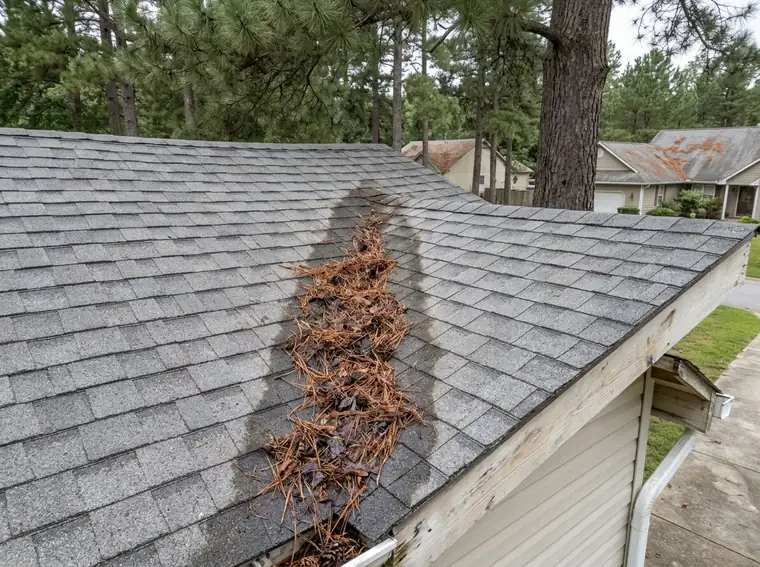
Pine Straw and Debris in Valleys
Debris turns a valley into a leak source on its own. Leaves and pine needles collect in the channel, hold water against the shingles and flashing long after the rain has stopped, and slow the drainage until water backs up under the roof covering. In Eastern NC, pine straw is the usual culprit. That is how a valley leaks even with sound shingles above it.
Other Leak Spots: Drip Edge, Gutters, Vents, and Nails
At the eaves, the drip edge is a small metal strip that carries water from the roof edge into the gutter. When it is missing or bent, water runs behind the fascia and stains ceilings near outside walls. Overflowing gutters do the same thing: a gutter choked with leaves spills water behind the fascia, and the stain hugs an outside wall. Regular gutter cleaning and repair keeps that water moving.
Other penetrations count too. Box vents, bathroom and kitchen exhaust vents, and old satellite dish mounts all cut through the roof, and each one needs its own seal.
Then there are the nails. A shiner is a nail that missed the rafter it was aimed at and pokes through the deck into the attic, shining in a flashlight beam. Water running down the deck finds the nail and follows it through, so shiners often sit on a water track. Backed-out nails do the same work from above: a nail head that has risen about an eighth of an inch leaves a tiny gap under the shingle, and wind-driven rain seeps in around it.
How to Find Where Your Roof Is Leaking: 4 Clues
You do not need to climb the roof to narrow it down. Start with the stain, then the rain, then the ground, then the attic.
1. Where Is the Stain?
Ask what sits uphill of it. A stain near a chimney, a skylight, or a wall points at flashing. A stain on a bathroom ceiling points at a pipe boot. A stain that follows a line down from where two slopes meet points at a valley.
2. When Does It Grow?
A leak that only appears in hard rain, or only when rain blows from one side, points at a joint that sheds normal rain but fails when water is pushed sideways or held against it. In Eastern NC, nor’easters and storms during the Atlantic hurricane season drive rain sideways for hours, which is when these joints give up. Wind direction is evidence: a leak that only fires when rain comes from the east points at the fittings on the east face. A leak that grows in dry weather, or after showers and laundry, is probably not the roof at all.
3. What Do You See From the Ground?
Use binoculars. Rust streaks or lifted metal near a chimney, a cracked boot collar, debris sitting in a valley, a gutter overflowing at one corner: each one is a visible clue. Do not climb onto the roof. A wet or steep roof gives almost no grip.
4. What Does the Attic Show?
Go up during steady rain if you can do it safely, and follow the dark track uphill to its highest point. The fitting at the top of it is the one to check first. Our step-by-step attic leak guide walks through it in detail.
Roof Leak Mistakes That Make It Worse
The most common mistake is sealing the wrong place. Smearing sealant around a fitting can dam the water draining past the joint, backing it up against the decking until it comes through anyway. That is why so many sealed boots and chimneys keep leaking: the sealant was put below the entry point, where it traps water instead of shedding it. Sealant is a backup to layered metal, never a substitute for it.
Sealing from inside the attic is worse: caulk or foam sprayed on the underside of the deck traps water inside the roof. The fix is always outside, at the entry point, with the failed piece removed and replaced in the right order.
When to Call a Roofer About a Leak
Two situations should not wait. If water comes through a light fixture, do not touch it: put a bucket under the drip, keep hands and towels away, and switch that circuit off at the breaker if it is actively dripping. A bulging or sagging ceiling holds pooled water above it, so keep people out from under it and treat it as a call today. Our emergency roof repair team handles active leaks like these.
Knowing where roof leaks start helps you describe the problem clearly when you call. Call a roofer when the stain keeps growing, decking feels soft, water drips rather than stains, the leak shows near lights or wiring, or your trace ends at a cracked or lifted fitting. Prado’s Roofing NC LLC traces leaks from the attic side and the roof side and fixes the source, not the symptom, starting with a free roof inspection in Washington NC. With 15 years of roofing experience across Washington, New Bern, Greenville, Belhaven, Chocowinity, and Bath, we would rather show you the true entry point than sell you a patch over a stain. To book, call (252) 999-4827.
If your trace ends at a fitting over a Washington room, our roof repair team in Washington NC handles that fix, as do our leak repair work for New Bern homes, our roof repair service in Greenville NC, and our roof repair work for Belhaven homes.
Roof Leak FAQs
Where do roof leaks start most often?
At flashing, pipe boots, and valleys, in that order. Those are the joints where the roof surface is cut.
Why does flashing fail first?
Because it does the hardest work on the roof. It bridges two materials that move at different rates, and it is tested hardest by wind-driven rain.
How long does a pipe boot last?
A standard rubber boot lasts about 10 to 15 years, and Eastern NC sun and heat push most boots toward the short end. The shingles around a boot usually last far longer.
Can a valley leak with sound shingles above it?
Yes. The shingles above a valley can look perfect while the membrane below has failed, a nail sits too close to the centerline, or debris has dammed the channel.
What is a shiner nail doing in a roof?
A shiner is a nail that missed the rafter it was aimed at and pokes through the deck into the attic. Water running down the deck finds the nail and follows it through, so shiners often sit on a water track.
Why does my roof only leak when it rains hard?
Because the opening is a joint that sheds normal rain but fails when water is pushed sideways or held against it.
My roof is new, why is it leaking?
A new roof rarely leaks in the shingle field. It leaks at the details: flashing never integrated, a boot missed or reused, or a valley laid in the wrong order. Document it with dated photos and call the installer back before patching anything yourself.
How can I tell if a leak is from flashing or shingles?
Look at where the stain sits. A stain near a chimney, wall, skylight, or vent points at flashing. A stain in the open middle of a ceiling, under an older roof with worn or missing shingles, points at the shingles themselves.