
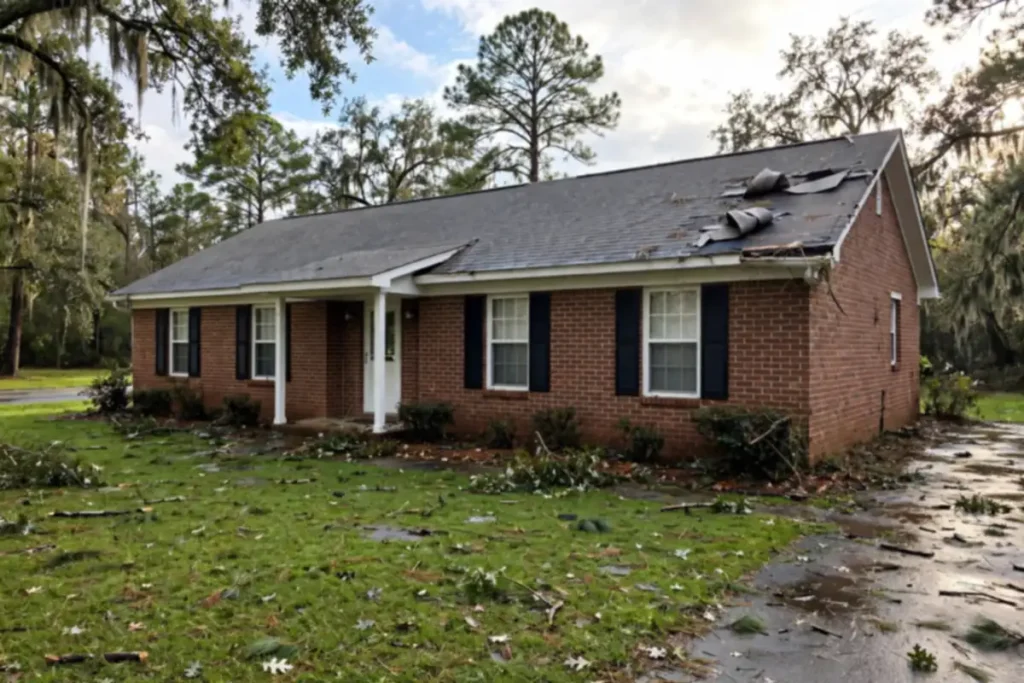
The storm has passed. Shingles lie in the yard, and a stain is spreading on the ceiling. Before anything else, you need to know whether your homeowners insurance pays for the damage. In Eastern North Carolina, where hurricanes, tropical storms, and nor’easters test roofs every season, that question has a North Carolina answer. Two facts decide most claims: the cause decides coverage, and your deductible and valuation decide the payout. The answers below come from the North Carolina Department of Insurance and the coastal insurance pool.
Does Homeowners Insurance Cover Roof Damage in NC?
Yes, when sudden damage from a covered peril causes it, and no, when gradual wear, aging, or neglect causes it. Homeowners insurance covers direct physical damage to your roof from wind, hail, fire, lightning, and falling objects, up to your dwelling limit and minus your deductible. It does not pay to replace a roof that simply wore out.
An adjuster starts with the cause, not the symptom: the same leak can be covered or excluded depending on what opened the roof.
Covered perils include wind, hail, fire and lightning, falling objects including trees, the weight of ice, snow, or sleet, and vandalism. Most North Carolina homeowners policies use the HO-3 form, under which dwelling coverage is open peril: damage is covered unless the policy excludes it. Other forms list covered perils instead. Your declarations page names your form, limits, deductible, and endorsements.
Policies do not cover wear and tear, aging and neglect, faulty workmanship or defective materials, flood and rising water, cosmetic damage that does not affect how the roof sheds water, or prior damage. If a tree falls on your home, your own policy usually covers the damage. Most policies also pay a limited amount, often a few hundred dollars per loss, to remove a tree that damaged a structure or blocked a driveway. Check your policy for your exact limit.
Storm Damage vs. Wear and Tear: How an Adjuster Tells Them Apart
Adjusters read pattern, timing, and collateral evidence together, not one shingle alone. Storm damage is local and directional, strikes the slopes that faced the wind, and dates to one event. Wear and tear is even, follows no storm date, and grows worse a little at a time.
Wind is the usual culprit in Eastern NC. It lifts tabs, breaks the sealant strip that bonds one course to the next, and leaves a crease line where the tab folded back. A nor’easter can unseal a whole row without tearing a single shingle off, so the roof looks fine from the ground while the next storm finds the loose courses first. Wind also strips ridge caps, which sit exposed at the peak, and drops limbs that crack shingles and dent gutters.
Hail is less common here, but it happens. It bruises shingles, knocks granules loose, and leaves dents in gutters, vents, and flashing on the same slopes. Damage bunched on the slopes that faced the storm, with the sheltered slopes nearly clean, points to a storm. Granule loss and brittleness spread evenly across every slope, with no directional pattern, points to age instead.
Your best evidence is a dated record tying damage to one storm: photos, storm date, maintenance history. If a storm just passed over Washington, start with storm damage roof repair in Washington NC and get that pattern documented before repairs begin.
| Factor | Storm damage | Wear and tear |
|---|---|---|
| Cause | One event: wind, hail, debris | Time, weather, neglected upkeep |
| Timing | Appears with a dated storm | Builds slowly over years |
| Pattern | Local, directional, slope by slope | Even, across the whole roof |
| Typical signs | Creased or missing shingles, bruising | Curling, cupping, brittleness, granule loss |
| Collateral evidence | Dented gutters, vents, flashing | None tied to one event |
| Insurance treatment | Covered if a peril caused it | Excluded as gradual deterioration |
| Evidence to collect | Dated photos, storm date, records | Repair history, prior reports |
Wind-Driven Rain, Leaks, and Flood: Three Different Water Problems
Rain through the roof is three coverage questions, not one. Wind-driven rain through an opening the wind or hail just created is treated as wind damage under typical policy wording. Rain through a gap that already existed is not covered. Rising water is flood, which North Carolina homeowners policies do not cover; flood insurance is separate, usually through the National Flood Insurance Program.
The same cause rule decides roof leaks: storm-caused openings can be covered, while age, worn flashing, and deferred maintenance are not. Our guide to where roof leaks start shows which joints fail first. Interior damage after a covered opening depends on your policy wording, so read the exclusions first.
The Three Deductibles on a North Carolina Policy
Your deductible is what you pay on a covered loss before the insurer pays anything. North Carolina policies can carry three, and they work differently.
| Deductible | When it applies | How it is calculated |
|---|---|---|
| All perils | Most claims | Flat dollar amount |
| Wind and hail | Any wind or hail loss, all year | Percentage of dwelling coverage |
| Named storm | Named storm losses only | Percentage of dwelling coverage, NWS window |
A named storm is a wind event named by the National Hurricane Center, the National Weather Service, or another recognized body, including hurricanes, tropical storms, and tropical depressions. The window starts when the National Weather Service issues an advisory, watch, or warning for any part of North Carolina, and ends 24 hours after the last one ends.
The percentage comes from your Coverage A dwelling limit, or in some policies your Coverage C limit, not from the cost of the damage. The North Carolina Department of Insurance gives this example: a 2% named storm deductible on a home insured for $300,000 is $6,000. Its wind and hail deductible example is 1% on $200,000, or $2,000. NCDOI gives 1% and 2% as examples only; Rate Bureau summaries describe 1%, 2%, and 5% options. A separate wind and hail policy carries its own deductible, so one storm can leave you with two.
Why Some Coastal Homes Carry Two Policies
A standard homeowners policy can exclude windstorm or hail. When it does, coastal homeowners buy a second policy for wind and hail, often from the North Carolina Insurance Underwriting Association, the Coastal Property Insurance Pool, still called the Beach Plan. The pool and its sibling, the FAIR Plan, are markets of last resort. Neither is a state agency.
The Coastal Pool covers wind and hail in 18 coastal counties. The FAIR Plan covers the rest of the state except the beach area. A wind and hail policy through the pool requires an active primary policy from an admitted carrier that excluded windstorm. Your primary insurer still investigates and adjusts the claim.
Washington and Belhaven sit in Beaufort County, and New Bern sits in Craven County, all inside the 18. Greenville sits in Pitt County, outside the pool’s territory. Homeowners there can start with storm damage roof repair in Greenville NC, and New Bern homes with our New Bern storm damage repair. Check your territory with your agent; rating territory follows ZIP code as well as county.
Will the Insurer Pay for the Whole Roof or Just the Damaged Area?
Often just the damaged area. The North Carolina Department of Insurance states that a homeowners policy covers direct physical damage, and the insurer only has to replace the damaged area, even if the shingles will not match. No statewide matching law forces full replacement for appearance; matching payment depends on your policy language and endorsements.
Brittle shingles can push a partial loss toward a larger repair, since lifting nearby courses may break them. When only part of a slope is damaged, our roof repair team can often scope the right repair, if surrounding shingles can be worked without breaking. If you are weighing the bigger picture, see how to decide whether to repair or replace your roof. From June 1, 2027, the new North Carolina homeowners program adds a material matching exclusion with an optional buyback, so ask your agent about matching before you need it.
RCV vs. ACV: Why the First Payment Is Smaller Than the Repair Bill
Two valuation methods decide what a covered loss is worth. Actual Cash Value, or ACV, pays the depreciated value: what the roof was worth at the time of the loss, after age and use. Replacement Cost Value, or RCV, pays what it costs today to repair or replace with similar materials.
RCV claims are commonly paid in two steps: the ACV amount first, then recoverable depreciation after the work is done and proven. Your policy’s Loss Settlement provisions control the mechanics. NCDOI notes you may claim additional RCV reimbursement within 180 days after the loss.
Roof age alone does not disqualify a claim. Age affects depreciation and underwriting, and some policies carry ACV endorsements for roof surfacing. Do not accept an age cutoff you read online as a North Carolina rule.
Under North Carolina’s new homeowners program, starting June 1, 2027, insurers can offer a Roof Payment Schedule that pays by roof age and material in exchange for a lower premium. The program also adds cosmetic damage and material matching exclusions, each with an optional buyback. Ask your agent which ones your policy will carry.
What to Do After the Storm: Steps That Protect Your Claim
Follow this order, which mirrors NCDOI guidance.
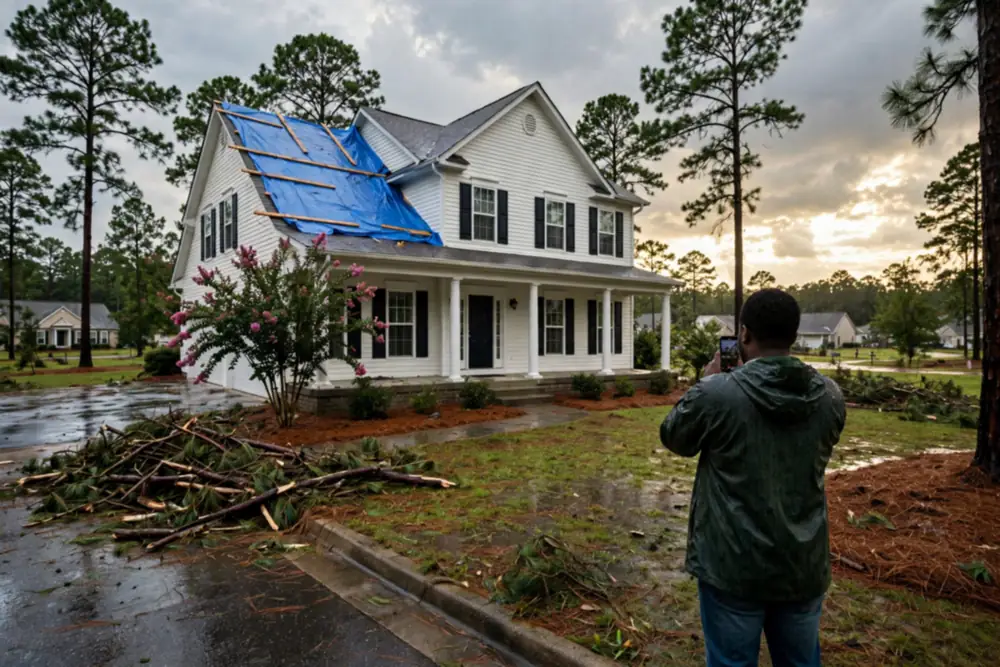
- Stay safe, then stop further damage. Stay off the roof, tarp open areas, move belongings out of the water’s path, and keep receipts.
- Photograph everything before repairs: the roof from the ground, debris in the yard, and every stain inside, with dates.
- Notify your insurer promptly, in writing, with the storm date, your observations, and your photos. Keep a copy.
- Make only temporary repairs until the insurer has inspected the damage, and keep damaged material until the visit. At the adjuster visit, stick to dates, events, and what you observed.
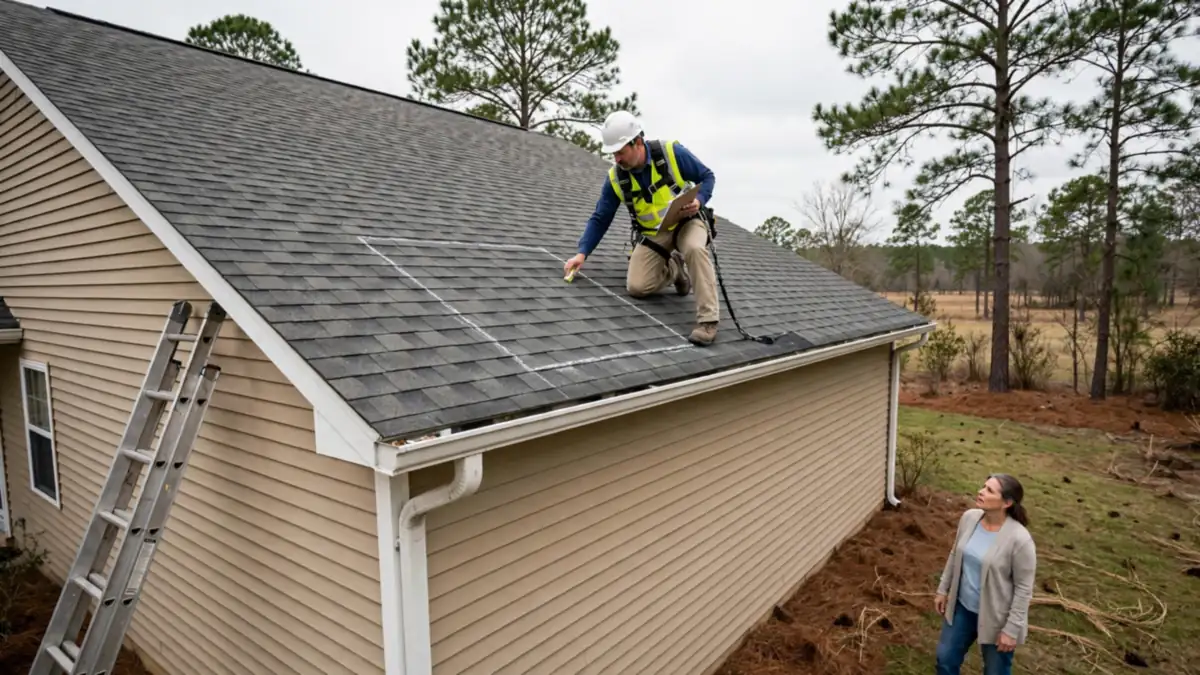
If water is coming in now, emergency roof repair covers tarping and mitigation while the claim moves forward. A free roof inspection before the adjuster visit gives you dated photos and findings to compare against the adjuster’s scope.
What a Roofer Can and Cannot Do on Your Claim
A roofer inspects, documents, estimates, and explains: photographing damage, writing a detailed estimate, and meeting the adjuster on site. A roofer cannot file your claim, negotiate it, or promise what your insurer will pay. Negotiating a claim for a homeowner is the work of a licensed public adjuster, and coverage decisions belong to the insurer alone. Your deductible is your share, so be wary of any contractor who offers to absorb or waive it, promises a free roof, or pressures you to sign unread.
Since October 1, 2024, North Carolina law gives homeowners a five-business-day cancellation period on residential roof replacement or repair contracts after an insurance claim denial, during which the seller may not start work or collect payment, except for emergency work you acknowledged in writing.
FORTIFIED Grants: A Brief Note
Two pilot grant programs from the Coastal Pool help eligible NCIUA policyholders replace a roof with an IBHS FORTIFIED Roof: Strengthen Your Roof offers up to $10,000 in territories 110 and 120, and Strengthen Your Coastal Roof offers up to $6,000 in territories 130 through 160. Grants are first come, first served, capped at the roof cost, and paid on completion. Since November 1, 2025, only Certified FORTIFIED Roofing Contractors may install a FORTIFIED roof under these programs. Funds are limited, so check current grant availability before you count on one.
Roof Insurance FAQs
Will insurance cover a 20-year-old roof after a storm?
Age alone does not disqualify a claim. What matters is whether a covered peril caused new damage and how your policy values it. Older roofs face heavier depreciation, so check your declarations page and endorsements.
How long do I have to file a roof claim after a storm in NC?
Notify your insurer promptly, in writing, and follow your policy’s Duties After Loss section. NCDOI says the insurer should acknowledge your claim within 30 days and that no fixed deadline sets settlement time. No single day count governs every NC policy.
What is the 25% rule, and does it apply in NC?
The 25% rule is a Florida building code rule about when a roof must be replaced rather than repaired. North Carolina’s residential code has no equivalent 25% replacement trigger. Confirm local requirements with your building department.
Will filing a roof claim raise my rates in NC?
It can. North Carolina insurers can apply claim-history surcharges or remove a claim-free discount, and the effect depends on your carrier, your claim history, and the type of loss. A claim near your deductible may pay little while still going on your record, so ask your agent before you file.
Does insurance pay for emergency tarping?
Often, as mitigation. Your policy expects you to protect the roof from further damage, and NCDOI notes your reasonable expenses to do that, including emergency tarping, may be reimbursed. Keep receipts and photos, and confirm with your insurer, since wording and deductibles vary.
This is general information, not insurance or legal advice. Your policy wording decides your coverage.
Your Next Step After the Storm
Three things decide the outcome: what caused the damage, what your policy says, and what you can show happened. Read your declarations page, photograph the damage, and get a written inspection before the adjuster visit. Prado’s Roofing NC LLC inspects storm damage, documents it, and explains the scope in plain words, starting with a free roof inspection and a free written estimate. With 15 years of roofing experience across Washington, New Bern, Greenville, Belhaven, Chocowinity, and Bath, we start with the evidence. Call (252) 999-4827 or request a free written estimate through our quote form.